
Our Work
Research
Research & Publication
Research
The UCLA CalKIDS Institute engages in research and evaluation about the CalKIDS Program. We work with multiple partners, including the ScholarShare Investment Board, county offices of education, schools and colleges, and community organizations to better understand the experiences of CalKIDS eligible youth and their families, and to understand best practices for encouraging students to learn Tabout, claim, and use their CalKIDS accounts.
The research team has recently published an initial report on one strand of our research: the experiences of the first cohorts of post-secondary students who used funds from their CalKIDS accounts.
In this report we highlight the perceived impact of the CalKIDS accounts on multiple parts of the post-secondary experience of students, such as continuing education and addressing short-term financial needs.
We also stress the importance of finding out about CalKIDS accounts early, as we found a positive relationship between the average impact that having a CalKIDS account had on students’ decisions to continue their education with the amount of time that the students had a CalKIDS account before graduating high school.Additionally, we underscore the importance of K-12 partnerships in helping young people learn about their CalKIDS accounts, as 43% of study participants reported that they first learned about CalKIDS through their high school.
This research was presented at the California Early Wealth Account System (CEWAS) Summit with Catalina Cifuentes of the Riverside County Office of Education (RCOE), who added onto our research by exploring ways in which RCOE has successfully helped students and families learn about and claim CalKIDS accounts.
In additional research activities, Dr. Mark Hansen, Faculty Director at the UCLA CalKIDS Institute, and Nayiri Nahabedian, Executive Director of the UCLA CalKIDS Institute, recently collaborated with the ScholarShare Investment Board and the California Child Savings Account Coalition to write and publish the California Early Wealth Accounts System (CEWAS) Plan.
The CEWAS Plan suggests a path to strengthen and build on early wealth-building, including the CalKIDS Program, in California. Previously, Mark Hansen and Nayiri Nahabedian also collaborated with Libby Schaaf, providing support for her report: Advancing CalKIDS: Findings & Recommendations for the Nation’s Largest College Savings Account Program.
Ongoing and future research of the UCLA CalKIDS Institute includes a case study of a county office of education with some of the highest rates of CalKIDS accounts claimed in the state of California, to understand best practices for schools to help students claim their accounts. We also are engaging in a scoping literature review of work done on child savings accounts.
Submission Guidelines for External Contributors
We invite researchers and policy experts to showcase their work through the CalKIDS Institute by contributing to our platform focused on children’s savings, financial capability, and asset-building research.
The Submission Process
All submissions follow a two-step process:
- Initial Summary: Submit a 700–800-word summary outlining your core research question or thesis, the framework for your analysis, and its relevance to children’s savings or financial capability.
- Full Manuscript: Following a review of your summary, our team may invite you to submit a full manuscript for formal review and potential publication.
To begin, please send your summary to uclacalkids@ucla.edu. You will receive a response within approximately three weeks.
Selecting Your Submission Track
We recognize that impactful research takes many forms. Please select the track that best fits the “voice” and structure of your work. APA 7th is our preferred formatting guideline.
- Track A: Empirical Research & Data-Driven Studies Best for: Original studies using quantitative or qualitative data to test hypotheses or evaluate programs.
- Track B: Policy, Theory, & Discussion Papers Best for: White papers, policy critiques, and conceptual pieces. This track offers a flexible framework designed to support narrative-driven analysis and strategic thought leadership.
Track A: Template for Empirical Research Submissions
1. Title Page (1 page)
Author(s), affiliation(s)
Contact information (for corresponding authors)
Date
Optional: Acknowledgments
2. Abstract and Keywords (or Executive Summary) (0.5–1.5 pages)
3. Introduction (2–3 pages)
- Study/Project background
- Problem statement (explain why it matters)
- Literature positioning (what part of the literature is relevant to your topic)
4. Research Questions (1-1.5 pages)
- Research questions and hypotheses (for quantitative studies)
5. Review of Literature (2-3 pages)
- Key theories or history of research related to the topic
- Gaps in literature: Emphasize what we still don’t know
6. Conceptual Framework (Optional but encouraged) (1–2 pages)
- Things that will be studied and the logical framework of the study
- How will the study address the gaps in literature
- Key variables and high level definition
7. Methodology (3–5 pages)
- Research design
- Methods
- Data sources
- Sample description
- Operational definition of variables
8. Results / Findings (4–6 pages)
- Directly provide answers to research questions
9. Discussion (2–3 pages, include limitations of the study)
10. Policy & Practice Implications (1–3 pages)
11. Conclusion (1 page)
- Recap key findings
- Broader significance
- Future research directions
12. References
13. Appendices (optional)
(Scroll down for Track B)
Track B: Flexible Framework for White Papers & Discussion Pieces
The following structure is a recommended guide. We encourage authors to adapt these sections to best serve the logical flow of their specific argument or policy analysis.
1. Title Page (1 page)
- Author(s), affiliation(s), and contact information.
2. Executive Summary (1 page)
- A high-level snapshot of the problem, your central thesis, and your key takeaways.
3. The Landscape: Introduction & Context (2–4 pages)
- Rather than a standard “lit review,” use this space to set the stage. What is the current state of the policy or theory? Why is a new perspective needed right now?
4. The Core Thesis (1 page)
- Clearly state the central claim or the primary questions your paper explores. This serves as the “anchor” for the rest of your discussion.
5. Analysis & Argument Development (Length Varies: 6–10 pages)
- This section is yours to shape. You may organize it by thematic pillars, historical stages, or specific policy levers.
- The goal is a systematic exploration of your topic, using existing evidence, case studies, or theoretical reasoning to build a persuasive case.
6. Strategic Outlook: Policy & Practice Implications (2–4 pages)
- Translate your analysis into action. What should stakeholders, agencies, or practitioners do differently based on your findings? We value specific, forward-thinking recommendations.
7. Synthesis & Conclusion (1–2 pages)
- Briefly recap the significance of your argument and suggest where the conversation should go next.
8. References
Published
A Process Evaluation of CalKIDS: Participation and Perceptions
July 23, 2026
Publication 26-02
This study evaluates the school-age component of CalKIDS, examining the extent to which the program is reaching its target population, how students understand its purpose and benefits, and what barriers limit account claiming and fund use. The findings show that many students who claim their accounts use the funds within three years of leaving high school. The study concludes with a discussion of how to increase participation and fund use, providing insights for CalKIDS and children’s savings account policies in other jurisdictions.
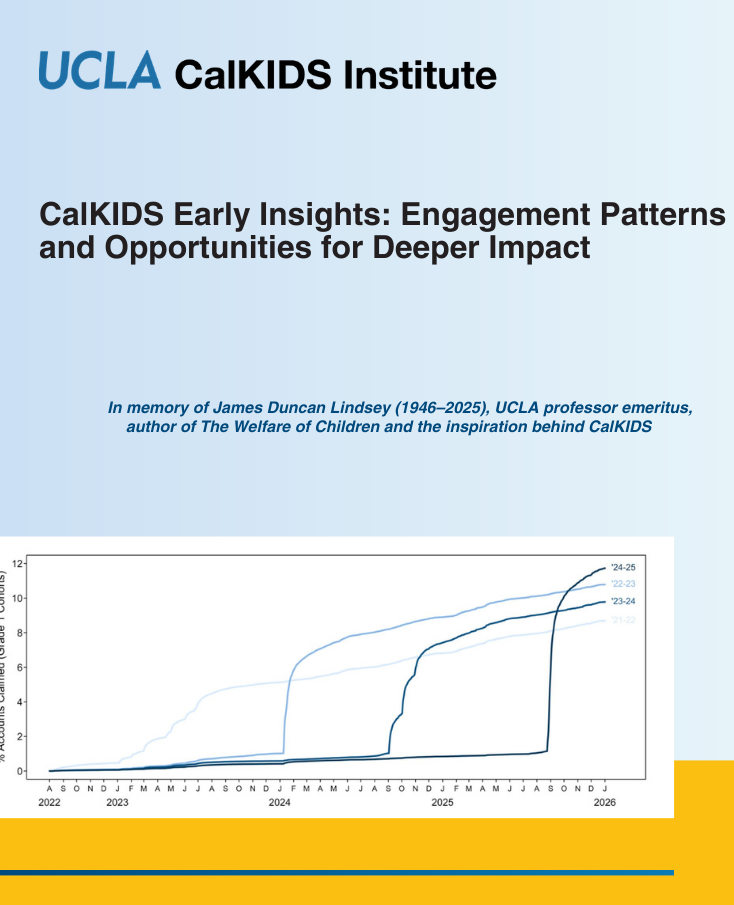
CalKIDS Early Insights: Engagement Patterns and Opportunities for Deeper Impact
March 10, 2026
Publication 26-01
The discussion paper explores early engagement patterns in the CalKIDS Program, focusing on the student track for school-aged children. It
highlights the importance of program awareness, claiming accounts, and
sustained engagement to maximize the program’s impact on college savings and financial capability. It offers several recommendations for strengthening the pathways through which families and students engage with the program. Finally, the paper emphasizes the broader value of CalKIDS in fostering financial awareness and educational aspirations, even beyond direct account claims.

Initial Report: An Examination of Post-Secondary Students Who Have Used CalKIDS Funds
June 21, 2025
Publication 25-01
This initial report provides preliminary insights into the experiences of the first cohorts of CalKIDS users (meaning those who have claimed and used at least some funds from their CalKIDS accounts for post-secondary education expenses). Through an online questionnaire and follow-up interviews, we examined the ways in which CalKIDS users learned about the program and used funds. Furthermore, we look into the perceived impact of CalKIDS by post-secondary students who have used funds from their account. In this report, we also highlight the importance of when students learn about their CalKIDS accounts.
Read the full report